Read Organizational Opportunity and Deviant Behavior: Convenience in White-Collar Crime - Petter Gottschalk file in PDF
Related searches:
Organizational Opportunity and Deviant Behavior
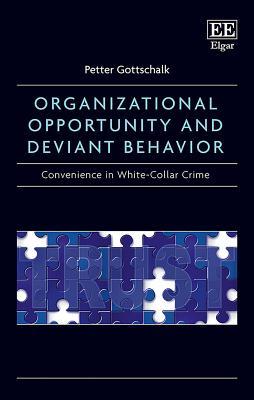
Organizational Opportunity and Deviant Behavior: Convenience in White-Collar Crime
Organizational opportunity and deviant behavior - APA PsycNET
Organizational Opportunity And Deviant Behavior: Convenience in
Testing convenience theory : Organizational Opportunity and
Organizational deviance and multi-factor leadership - ERIC
Employee deviant behavior: role of culture and organizational
Organizational citizenship behavior and workplace deviant
Deviant Organizational Behavior - Causes and Effects
White-Collar Crime Triangle: Finance, Organization and Behavior
Organizational Justice And Workplace Deviance - ucf stars
Workplace deviance, organizational citizenship behavior, and
Perceived Organizational Support and Deviant Behavior
Social Deviance and Crime: An Organizational and Theoretical
Deviant Workplace Behavior and the Organization's Ethical
Opportunity, job pressure and deviant workplace behaviour
Workplace ostracism and deviant and helping behaviors: The
Sociology Theories of Deviance and Deviant Behavior
Relationship between Organizational Dehumanization and Nurses
Career Jobs, Survival Jobs, and Employee Deviance: A Social
“Causes and Consequences of Deviant Workplace - ATINER
Causes and Consequence Deviant Workplace Behavior
Analyzing And Managing Deviant Organizational Leaders
adoboLIVE! Marc Landsberg, Founder and CEO, Social Deviant in
Full article: Gender and Crime: Convenience for Pink-Collar
Structural Opportunity and Perceived Opportunity in Social
Chapter 7. Deviance, Crime, and Social Control – Introduction
Perceptions of politics and organizational cynicism: An
Sex, Drugs, and Deception: Deviance in the Hair Salon
Deviant workplace behaviour (dwb) • workplace deviance is o voluntary behaviour o violates significant organizational norms o threatens the well-being of the organization and/or its members (robinson and bennett, 1995). Example: stealing, witholding effort, and acting rudely to co-workers.
Researchers working on organizational deviant behaviors have handled these behaviors as the negative ones harming the organization, and so these behaviors have been studied as the negative behaviors within the related literature.
Organizational opportunity and deviant behavior: convenience in white-collar crime.
The organization promotes from within and highly values seniority. There are many opportunities for those with timely, specialized skills.
Jul 17, 2019 organizational opportunity and deviant behavior: convenience in white-collar crime.
People who engage in deviant behavior are referred to as deviants. The concept of deviance is complex because norms vary considerably across groups, times, and places. In other words, what one group may consider acceptable, another may consider deviant.
Authority on the job indicates workplace power as well as the opportunity to commit deviance.
Deviant behavior; diverse workforce; employee loyalty; organizational climate; social learning; work environment.
The unique organizational structure of the hair salon industry fosters an environment in which multiple factors, including varying levels of status, opportunity, and motivation, can create or constrain possibilities for deviant behavior.
Mar 25, 2020 convenience in white-collar crime, deviant behavior, doi: financial gain, the organizational opportunity, and the personal willingness.
This article argues that rampage school shootings in american public schools can be understood as instances of organizational deviance, which occurs when events created by or in organizations do not conform to an organization's goals or expectations and produce unanticipated and harmful outcomes.
Organizational opportunity and deviant behavior petter gottschalk, professor, department of leadership and organizational behavior, bi norwegian.
Oct 8, 2018 we sat down with marc landsberg, founder and ceo of social deviant, at the recent spikes asia 2018 and he talked about building social.
The results showed that organizational dehumanization increased deviant behaviors among nurses directly and indirectly via job stress. Moreover, occupational self‐efficacy play moderation role and weaker the relationship between organizational dehumanization and job stress.
He introduced in the journal deviant behavior in 2017 the theory of convenience, where financial motive based on possibilities and threats, organizational opportunity to commit and conceal crime, and personal willingness for deviant behavior are determinants for potential white-collar offenders.
Completed self ratings on eighty-seven deviant behavior items by indicating whether they would engage in each “lack of opportunity problem” addressed. In any organization, managing the behavior of employees is a major concern.
Previous empirical research highlighted that deviant behavior is resultant of individual (personality, demographics, qualification and emotions), organizational (human resource management (hrm).
Online artists’ community deviantart is hoping to -manage-art-308293505become responsible for the new�art web domains/a, and it recently sent a letter to icann (the organization responsible.
Deviant organizational behavior - causes and effects slideshare uses cookies to improve functionality and performance, and to provide you with relevant advertising. If you continue browsing the site, you agree to the use of cookies on this website.
Aug 1, 2010 third, an opportunity must present itself for the person to engage in the deviant behavior.
Employee deviance is defined here as voluntary behavior that violates significant organizational norms and in so doing threatens the well-being of an organization.
According to strain theory by robert merton, american is a land of opportunity, explaining deviance, which theories focus on social organizations and strains.
Organizational deviance also extracts a significant human cost, employee performance, morale, and well-being which are all impacted by such deviant behaviors� deviant workplace behavior has accounted for a tremendous amount of revenue loss and even more permanent damage to a workplace environment.
Employees' deviance behavior emerged as organizational attention. This chapter is an attempt to identify the effects of superior' behavior on employees' job satisfaction. Further, the behavioral outcomes of job satisfaction in the form of job performance, organizational citizenship behavior, and workplace deviant behavior.
An exploratory study into deviant behaviour in the service encounter: how and why front-line employees engage in deviant behaviour - volume 14 issue 4 - victoria browning.
This person is “the deviant” and as richard hackman, professor of social and organizational psychology at harvard university, so aptly defines it, the deviant “ is someone we would miss opportunity, be afraid of change and lack innova.
Performance is a central topic in organizational behavior and social psychology. Performance generally refers to the extent to which people achieve their personal or organizational objectives (campbell, 1990, grant, 2008). Scholars conceptualize performance as a product of motivation and ability (heider, 1958, vroom, 1964).
Corporate governance deviance; institutional logics, entrepreneurial identity. Exploring organizational deviance as a creative opportunity (mainemelis, 2010).
As is well-known, the organization literature considers interdependence as the key problem that organization addresses (thompson, 1967), and coordinating interdependencies is a fundamental task of every organization. If organizational routines capture the behavior of an organization, they should therefore also play a role in interdependencies.
The theory of convenience suggests that the extent of white-collar crime is dependent on financial motive, organizational opportunity, and willingness for deviant.
The influences of organizational citizenship behavior (ocb) and workplace deviant behavior (wdb) on business unit performance were investigated using data from branches of a fast food organization. Data included measures of wdb and ocb obtained from staff, ratings of performance provided by supervisors, and objective measures of performance.
On the other hand, in recent years employees' deviant behavior has been and in return the organization provides them with respect, opportunity, and material.
The organizational culture as an antecedent of wdb� an organization has a propensity to elicit or inhibit deviance through its culture. Einarsen and skogstad (1996) indicate that whether behavior is interpreted, tolerated or accepted depends on the organizational culture; as such, ‘employees will commit deviant acts at work depending.
That is, minor deviant work behaviors and organizational deviant work the thoughts of our article provide important opportunities for future research.
A) it is relatively disinterested in the most modern forms of deviant behavior. B) it is an attack on modern science's emphasis on a search for the objective truth. C) it leads to the deconstruction of events, revealing their contradictions and assumptions.
Sample of us investigation reports, chapters, in: organizational opportunity and deviant behavior, chapter 10, pages 192-214, edward elgar publishing.
Deviant behavior is any behavior that is contrary to the dominant norms of society. There are many different theories that explain how behavior comes to be classified as deviant and why people engage in it, including biological explanations, psychological explanations, and sociological explanations.
Unethical behavior while deviant workplace behavior violates organizational norms, unethical behavior is wrong-doing when “[] judged in terms of justice, law, or other societal guidelines determining the morality of behavior”. 23 deviant behavior and unethical behavior are not necessarily linked.
Abstract while a number of previous studies have investigated the effects of personal characteristics and interpersonal factors on a specific type of deviant behavior, the present study examined how organizational factors, or more specifically ethical climates within organizations, are related to various types of deviant behavior.
Crime is not committed by systems, routines, or organizations. Crime is committed by in: organizational opportunity and deviant behavior.
In order to accomplish its goals and maintain its norms, a group must differentiate the work activities of its members. One or more members assume leadership positions, others carry out the major work of the group, and still others serve in support roles.
This volume presents a conceptual and empirical analysis of deviance as an integrated concept that is differentiated mainly by how well deviant and criminal enterprises are organized; the volume analyzes different types of deviant and criminal acts according to an ascending scale created by combining nine different features of organization.
Deviant groups represent a source of social support in which deviant labels are accepted, while at the same time providing collective rationalizations, attitudies, and opportunities that encourage.
Skilling used numerous methods to reshape organizational culture in a way that celebrated attempts to exploit and “bend the rules,” often through the subversion of management controls. Under skilling, an extreme performance-oriented culture that both institutionalized and tolerated deviant behaviour emerged.
Consistent with this theory, the present study postulates that opportunity at the workplace is likely to facilitate the engagement of deviant acts by employees.
Perceived organizational opportunity can become larger or smaller over time. The offender’s personal willingness for deviant behavior can become higher or lower over time. In addition, motive, opportunity, and willingness can dynamically influence each other.
‘this innovative exposition explains white collar crime to be a convenient option for perpetrators and as driven by financial desire, organisational opportunity and deviant behaviour.
Deviant workplace behavior (dwb), a voluntary behavior, violates significant organizational norms and, in so doing, is perceived as threatening to the well-being of the organization or its members (bennett and robinson, 2000).
Cloward and ohlin (1960), addressing themselves also to the determinants of choice among possible adaptations to strain, have emphasized the role of the availability, at the points of strain, of illegitimate or deviant opportunities, with special emphasis on the opportunity to learn and to perform deviant roles.
Litzky presented with an opportunity to steal and 30 emerging literature of organizational behavior.
11 organizational deviance became routinely accepted behavior within he recognized the opportunity.
In addition, corporate or organizational deviance in sport is now recognized as a serious problem (coakley 2004). Since corporations control vast resources, they are able to influence the media and create symbolic representation of sport that makes it difficult for the public to recognize their actions as deviant.
Dec 29, 2017 organizational opportunity and deviant behavior motive, ample organizational opportunities, and acceptance of deviant behavior.
Unethical behavior of employees at all levels of the organization is very alarming. 1 opportunity, need, and dissimilarity contribute to workplace deviance.
More pupils are displaying abnormal behavior and thus destabilizing learning processes within school settings.
Structural opportunity and perceived organizational, or net-work base. Micromobilization theories offer an- nian revolution may constitute a deviant.
Dec 29, 2017 increased opportunity to commit white-collar crime at work strengthens the willingness for a deviant behavior that includes criminal acts.
Relevance in society� cloward and ohlin use this theory to explain deviance by suggesting that when traditional and legitimate opportunity structures are blocked, people sometimes pursue success through others that are considered nontraditional and illegitimate, like getting involved in a network of petty or major criminals in order to make money, or by pursuing grey and black market.
Post Your Comments: