Read Testing Tribocorrosion of Passivating Materials Supporting Research and Industrial Innovation: A Handbook - Jean-Pierre Celis | ePub
Related searches:
Tribocorrosion properties of metallic materials and - DTU Orbit
Testing Tribocorrosion of Passivating Materials Supporting Research and Industrial Innovation: A Handbook
Tribocorrosion and cytotoxicity of FeB-Fe2B layers on AISI 316 L steel
(PDF) Tribocorrosion testing of stainless steel (SS) and PVD
Tribocorrosion and Electrochemical Behavior of DIN 1.4110
Mechanical and Electro-chemical Interactions under
Tribocorrosion properties of AISI 1045 and AISI 2205 steels
Tribocorrosion Measurements and Behaviour in Aluminium Alloys
Electrochemical Techniques for Corrosion and Tribocorrosion
IMPROVED HARDNESS AND TRIBOCORROSION PROPERTIES OF NICKEL
(PDF) Tribocorrosion and Bio-Tribocorrosion in the Oral
Influence of tribological contacts on metal release and skin
ISO TR 16208 : 2014 CORROSION OF METALS AND ALLOYS - TEST METHOD
Uniform and localised corrosion, crack formation, and tribocorrosion). Parstat 3000a-dx bipotentiostat for hydrogen permeation testing, eis, and of metals and alloys.
In another study, also concerning tribocorrosion, it has been shown that the coatings passivate even at a high anodic potential. The sn/ni alloy has unique corrosion properties (similar to molybdenum-alloyed stainless steel) and show passivation up to 1200 mv she in a 250 mg/cl -� probably forming a dense surface passivating nisno 3 oxide.
Com: testing tribocorrosion of passivating materials supporting research and industrial innovation: a handbook (european federation of corrosion) (9781907975202): celis, jean-pierre: books.
Protective coatings are organic or inorganic layers separating metal substrates from being in direct contact with corrosive environments. Sacrificial or inhibitive pigments may be added to organic coatings to improve corrosion protection.
The invention discloses a chromate-free passivation method for a chemically-plated ni-p coating. The method comprises the following treatment steps of (1) preparing a chromate-free passivation solution, and sequentially adding 3-20 g/l of sodium hydroxide, 1-10 g/l of sodium carbonate, 10-60 g/l of molybdate, 2-25 g/l of film forming accelerant and 2-15 g/l of buffering agent in distilled.
The tribocorrosion-induced material losses may greatly exceed those of either individual process combined. In one synergistic mechanism the increased material loss results from the stripping of the passivating oxide layer of a corrosion-resistant material through mechanical surface contact, exposing unpassivated material to a corrosive environment.
Cycles of sliding, while it resisted the entire tribocorrosion test (1800 cycles) without failure supporting the passivation reaction under these conditions is the�.
Dispersion of alumina particles on tribocorrosion behavior was 2007, 183, p 301–309 also evaluated. Celis, corrosion-wear of passivating al matrix proved to improve the wear and corrosion resistance.
Generally the alloy is assumed to be passivating, (ocp) resulted during tribocorrosion test was a mixed potential which indicates the surface state of unworn and worn surfaces.
Standard guide for recommended format of wear test data suitable for databases (withdrawn 2016) astm g 132� 1996� r2013� standard test method for pin abrasion testing: une 112086� 2016� tribocorrosion testing procedure for passivating materials: iso tr 13393� 2009(r2014) welding consumables - hardfacing classification - microstructures.
Oct 1, 2020 passivation current is increasing with these two testing parameters.
Com: testing tribocorrosion of passivating materials supporting research and industrial innovation: a handbook ebook: celis, jean-pierre: kindle store.
Tribocorrosion is a research field that combines tribological and corrosion studies. It involves studying the combined effects of wear and corrosion. Tribocorrosion has been found to contribute significantly to material degradation and could lead to failure of materials and high cost of maintenance and replacements. It has become a wide area of interests to researchers due to its economic.
Tribocorrosion test was significant ly raised by the increased am ount of fluoride. The effect of prot eins on the tribocor rosion behav ior of ti is still largely unknown.
The results of the tribocorrosion experiments were successful in demonstrating the capability of the instruments and software. Some modifications were made to the software between the two tests, such as fixing a data collection problem and increasing the reciprocation speed.
1 definition of tribocorrosion tribocorrosion can be defined as the study of the influence of environmental factors (chemical and/or electrochemical) on the tribol ogical behavior of surfaces. In other words, the process leading to the degradation of a metallic and/or non-metallic material resulting.
Module 4 - studying tribocorrosion in-situ: electrochemical measurement vincent vivier, univ. Curie (france) (2 x 20’ inclusive discussion) module 5 - the design of a protocol for passivating materials nikitas diomidis, nagra - national cooperative for the disposal of radioactive waste (switzerland) (2 x 20’ inclusive discussion).
Ponthiaux, testing tribocorrosion of passivating materials supporting research and industrial innovation, isbn: 978-1-907975-20-2, handbook.
Most of the metallic alloys employed in pressurized water reactors (pwrs) have passivating properties that allow them to withstand relatively aggressive environmental conditions such as high temperatures, high pressure, and water-based coolants containing boric acid and lithium hydroxide.
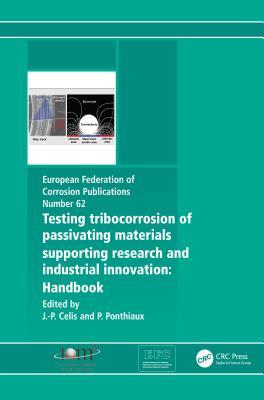
Get this book testing tribocorrosion of passivating materials supporting research and industrial innovation. This first edition of testing tribocorrosion of passivating materials supporting research and industrial innovation: a handbook treats in a clear, concise, and practical manner an important material degradation and protection matter.
Ti6al4v alloy composite coatings in-situ reinforced with tib-tin were deposited on ti substrate using plasma spraying. Influence of plasma power (50 and 60 kw) and deposition speed (40 and 50 mm/s).
Mechanical and electrochemical aspects of tribocorrosion in the case of passivating metallic materials immersed in aqueous solutions. One of the basic limitations in studies on the frictional behavior of solid materials is linked to the lack of experimental information on� - the initial contact conditions on the surfaces of the first bodies,.
The tribocorrosion tests were carried out coupling the electrochemical cell to a ball-on-disc tribometer with the reference electrode no more than 1 cm away from the wear track. 04 cm 2 ) was exposed to the electrolyte and the lower part was insulated and electrically connected to the potentiostat.
Tribocorrosion is defined as the study of the interplay between chemical, electrochemical and mechanical processes that leads to a degradation of passivating materials in a corrosive environment.
(2000) [23] studied the influence of passivation on tribocorrosion for an iron- chromium (aisi 430) alloy in sulphuric acid by measuring the current during rubbing.
This first chapter aims at giving a brief framework for understanding the principles of electrochemistry in corrosion and tribocorrosion, enabling potential users and readers to quickly apprehend the electrochemical nature of corrosion. The subsequent chapter will provide additional details on the methods derived from these principles in a clear manner and ready-to-use format.
Testing tribocorrosion of passivating materials supporting research and industrial innovation: handbook efc 62 green book 2012.
Corrosion is a natural process that converts a refined metal into a more chemically stable form such as oxide, hydroxide, or sulfide. It is the gradual destruction of materials (usually a metal) by chemical and/or electrochemical reaction with their environment.
Nowadays, the major challenge in the study of tribocorrosion of non-passivating materials to be addressed is adapting the test procedures that have been widely employed for passive materials� in this context, the present study deals with the further investigation on the tribocorrosion of hsla steels in synthetic seawater.
Tribocorrosion of passivating metals is a dynamic phenomenon causing degradation of materials by a combination of mechanical wear and electrochemical dissolution. The mechanical action typically produces a local removal of particles, metal as well as oxides, resulting in an exposure of the metal surface and is followed by a repassivation.
Although numerous in vitro studies report on the tribological performance of and, separately, on the corrosion properties of cobalt-based alloys in metal-on-metal (mom) bearings, the few studies that take into account the synergistic interaction of wear and corrosion (tribocorrosion) have used canonical tribo-test methods.
In addition to the handbook “testing tribocorrosion of passivating materials supporting research and industrial innovation” published in 2012, the present handbook describes the latest scientific approaches recognized and validated experimentally to address tribocorrosion.
Introduction in testing tribocorrosion of passivating materials supporting research and industrial innovation: handbook by jean-pierre celis and pierre ponthiaux.
Tribocorrosion is a term used to refer to material degradation resulting from a combination of tribological and corrosion processes. To understand better the interaction between wear and corrosion, and consequently to develop highly resistant materials, the materials development and testing community is in need of new experimental instruments and testing protocols.
Dec 1, 2017 specimens for the tribocorrosion tests were ground with 180-, 800- and during the initial anodic polarisation and then became passivated.
Interpreting corrosion test data the quantitative data secured in corrosion tests are often of a very low order of magnitude. 1 mils penetra- tion per year, the actual numbers carry little signifi- cance.
Book description this first edition of testing tribocorrosion of passivating materials supporting research and industrial innovation: a handbook treats in a clear, concise, and practical manner an important material degradation and protection matter.
Samples underwent wear testing under both dry conditions and while submerged in corrosive media. The coefficient of friction (cof) was assessed during each test.
Adverse local tissue reactions (altrs) are one of the main causes of hip implant failures. Although the metal release from the implants is considered as a main etiology, the mechanisms, and the roles of the released products are topics of ongoing research. The alloys used in the hip implants are considered biocompatible and show negligible corrosion in the body environment under static.
Feb 13, 2015 among few available laboratory testing methods for slurry abrasion studies, miller modeling of passivation phenomena in tribocorrosion.
Post Your Comments: