Read The History of Philosophical and Formal Logic: From Aristotle to Tarski - Alex Malpass and Marianna Antonutti Marfori file in ePub
Related searches:
The History of Philosophical and Formal Logic: From Aristotle to
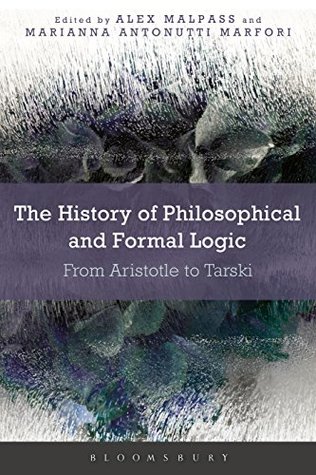
The History of Philosophical and Formal Logic: From Aristotle to Tarski
The History of Philosophical and Formal Logic: From - Amazon.com
The History of Philosophical and Formal Logic from Aristotle to Tarski
The History of Philosophical and Formal - Bloomsbury Collections
The History of Philosophical and Formal Logic: From - Goodreads
The History of Philosophical and Formal Logic i Apple Books
Amazon.com: The History of Philosophical and Formal Logic
The History of Philosophical and Formal Logic 1st edition
Philosophy and History of Mathematics - Department of Philosophy
Formal languages logic philosophical and cognitive analysis Logic
History and Philosophy of Logic - ResearchGate
Michael Scanlan, The History of Philosophical and Formal
The history of philosophical and formal logic from Aristotle
(DOC) History of Formal and Philosophical Logic: from
Formal Methods and the History of Philosophy SpringerLink
Guide for authors - Studies in History and Philosophy of Science
History, Philosophy and Science Teaching - Laboratorio Grecia
Philosophical and Formal Approaches to Linguistic Analysis
Philosophy: Historical Overview and Recent Developments
Formal Methods and the History of Philosophy Request PDF
History and Philosophy BA University of Leeds
Metaphysics: Historical Background and Traditional Metaphysical
History and Philosophy of Biology - Book Series - Routledge & CRC
The History of Philosophical and Formal Logic eBook by
A Scientific History and Philosophical Defense of the Theory
History and Timeline of the Medal of Honor
2017 the History of Philosophical and Formal Logic From
The Origins and Branches of Philosophy - roangelo.net
Ontology: Theory and History
Foundations of the Formal Sciences VIII: History and
Timeline and History of Respiratory Therapy - AARC
Form and Function: Aristotle's Four - History of Philosophy
Plato’s Philosophy of Education and the Common Core debate
6 oct 2015 in this paper we present a philosophical motivation for the logics of formal inconsistency� a family of paraconsistent logics whose distinctive.
The history of philosophical and formal logic introduces ideas and thinkers central to the development of philosophical and formal logic.
The word 'philosophia' was coined around the late 7th or early 6th century bce to describean activity that had arisen at that time in the greek-speaking cities in ionia (western asia minor -modern-day turkey). This activity seemed striking enough to the people of that time and place towarrant the invention of this new name; that is, they felt that this activity did not fit thedescription of any of the other activities people tended to be involved.
Logic is the formal science of using reason and is considered a branch of both philosophy and mathematics and to a lesser extent computer science. Logic investigates and classifies the structure of statements and arguments, both through the study of formal systems of inference and the study of arguments in natural language. The scope of logic can therefore be very large, ranging from core topics such as the study of fallacies and paradoxes, to specialized analyses of reasoning such as probabilit.
This article traces the history of systematic african philosophy from the early 1920s to date. In plato’s theaetetus, socrates suggests that philosophy begins with wonder. However, recent research shows that wonder may have different subsets.
The formal cause of the history of philosophy podcast is peter adamson's voice, the material causes are sound waves and data files, the efficient cause is peter adamson, and the final cause is the entertainment and education of strangers?.
The introduction, by the editor admir skodo, argues that philosophical thinking about logic continues to be dominated by certain well-entrenched ideas about its nature: that logic is inherently formal; that it constitutes a self-contained system, rather than existing in concrete human acts and their contexts; that formal logic provides the best conception of thinking and that it is the duty of logic to replace the multiplicity of imperfect ways of reasoning with the one true logic.
The problems of authority, law and order, obligation, and self-interest first became central topics of speculation in the thought of the sophists (late fifth and early fourth centuries bce). The most famous sophists all stressed the distinction between nature ( physis ) and convention ( nomos ), and they put laws in the latter category.
Although not (yet) entirely mainstream, uses of formal methods for the study of the history of philosophy, the history of logic in particular, represent an important trend in recent philosophical.
We raise the matter only to lend some philosophical perspective to the formal treatment that follows. Here we develop the basics of a formal language, or to be precise, a class of formal languages. Again, a formal language is a recursively defined set of strings on a fixed alphabet.
The philosophy of kant sets forth, in the first place, the formal aspect of the task, but it has the abstract absoluteness of reason in self-consciousness as its sole result, and, in one respect, it carried with it a certain character of shallowness and want of vigour, in which an attitude of criticism and negativity is retained, and which, as far as any positive element is concerned, adheres to the facts of consciousness and to mere conjecture, while it renounces thought and returns to feeling.
7 mar 2019 this is a guest contribution by richard pettigrew, professor of philosophy at the university of bristol for our series how philosophers write:.
Reconstruction versus construction — the context distinction and its impact for philosophy and sociology of science.
The history of philosophical and formal logic: from aristotle to tarski.
Masses of formal philosophy now available! isbn 87-991013-1-9 (hardback) / isbn 87-991013-0-0 (paperback).
1 oct 2018 notes it focuses on great figures and periods: aristotle, the stoics, the medieval logicians, leibniz, bolzano, boole, peirce, frege, peano, russell,.
Levine, md, establishes a primitive inhalation therapy program using on-the-job trained technicians to manage post-surgical patients at michael reese hospital in chicago.
17 aug 2006 they draw together historical, logical, and philosophical perspectives on the fundamental a historical, philosophical, and formal analysis.
Baumgarten introduced the term “aesthetic” into the philosophy of art it seemed to be taken up with the aim of recognising, as well as unifying, certain practices, and perhaps even the concept of beauty itself.
Positivism, in western philosophy, generally, any system that confines itself to the data of experience and excludes a priori or metaphysical speculations. More narrowly, the term designates the thought of the french philosopher auguste comte (1798–1857). As a philosophical ideology and movement, positivism first assumed its distinctive features in the work of comte, who also named and systematized the science of sociology.
History: additional physical format: print version: history of philosophical and formal logic from aristotle to tarski (dlc) 2016039911 (ocolc)970641420: material type: document, internet resource: document type: internet resource, computer file: all authors / contributors: alex malpass; marianna antonutti marfori.
The history of philosophical and formal logic from aristotle to tarski.
) the ancient greek philosopher thales was born in miletus in greek ionia. Aristotle, the major source for thales’s philosophy and science, identified thales as the first person to investigate the basic principles, the question of the originating substances of matter and, therefore, as the founder of the school of natural philosophy.
Tradition from leibniz through frege—the intellectual home of most of the philosophical projects for which it matters how logic is demarcated.
The history of philosophical and formal logic introduces ideas and thinkers central to the development of philosophical and formal logic. From its aristotelian origins to the present-day arguments, logic is broken down into.
Ideologies, in fact, are sometimes spoken of as if they belonged to the same logical category as religions. Both are assuredly in a certain sense “total” systems, concerned at the same time with questions of truth and questions of conduct, but the differences between ideologies and religions are perhaps more important than the similarities.
In contemporary philosophy, formal ontology has been developed in two principal ways. The first approach has been to study formal ontology as a part of ontology, and to analyze it using the tools and approach of formal logic: from this point of view formal ontology examines the logical features of predication and of the various theories of universals.
'completeness of an ecthetic syllogistic', notre dame journal of formal logic, 24, 224–32. 1305/ndjfl/1093870312[crossref]view all references, we prove.
The history of philosophical and formal logic: from aristotle to tarski [malpass, alex, marfori, marianna antonutti] on amazon.
Socrates, plato, and aristotle, whose lifetimes spanned a period of only about 150 years, remain among the most important figures in the history of western philosophy.
In this history of logic for undergraduate students with little or no background in formal logic, each chronological chapter focuses on one important figure or school of thought. Part 1 covers the origins of formal logic, with discussion of aristotle, the stoics, and medieval logic.
Background: philosophy and physiology while psychology did not emerge as a separate discipline until the late 1800s, its earliest history can be traced back to the time of the early greeks. During the 17th-century, the french philosopher rene descartes introduced the idea of dualism, which asserted that the mind and body were two entities that interact to form the human experience.
1 oct 2018 this book is intended for an undergraduate student who has taken one introductory course in first-order logic.
History of formal and philosophical logic: from aristotle to tarski. Introductionput simply, logic deals with the inference of one thing from another, such as the inference of a conclusion from the premises of an argument. An example of this would be the following:the emission of certain chemicals that harm the ozone layer is likely to cause global warming, and petrol-consuming vehicles emit these chemicals is large quantities; therefore, global warming is likely.
Adriane rini aristotle is generally credited with the invention of logic. More than two thousand years ago, he noticed that good, persuasive arguments.
He is also considered perhaps the most important logician between aristotle and the mid-19th century developments in modern formal logic.
The history of philosophical and formal logic introduces ideas and thinkers central to the development of philosophical and formal logic. From its aristotelian origins to the present-day arguments, logic is broken down into four main time periods:.
Reflection on self, the freedom above described is abstractly defined as the formal element of the activity of the absolute idea.
The history of philosophical and formal logic introduces ideas and thinkers central from its aristotelian origins to the present-day arguments, logic is broken.
If one were to paint a broad-brush history of western philosophy from ancient times, it would begin with the origins of philosophy and science together in ancient ontology and cosmogony (the pre-socratic philosophers from thales to democritus, culminating in aristotle) along with a heavy emphasis on the good and living well (socrates, plato, and aristotle through the stoics and the skeptics).
In the history of logic and philosophy, its significance is reflected in the writings of locke, whately, and mill. Today, this tradition manifests itself in textbooks and websites which attempt to teach good informal reasoning by teaching students how to detect the standard fallacies.
Roman philosophy after conquering the greeks, the romans became interested in philosophy. The most popular school of philosophy with the romans was stoicism. Stoicism taught that the universe was very ordered and rational. It said that everyone, regardless of their wealth and position, should always try to do their best.
29 jun 2017 the history of philosophical and formal logic book.
Aloysius martinich - 2003 - journal of the history of philosophy 41 (3):405-407.
Aristotle's syllogistic from the standpoint of modern formal logic.
History and philosophy of science (hps) and science education closer together, there is communicated in the classroom, which are not in line with the formal.
From the renaissance until the early 19th century aristotle's system of formal there was a medieval tradition according to which the greek philosopher.
Although not (yet) entirely mainstream, uses of formal methods for the study of the history of philosophy, the history of logic in particular, represent an important trend in recent philosophical historiography. In this chapter, i discuss what can (and cannot) be achieved by the application of formal methods to the history of philosophy, addressing both motivations and potential pitfalls.
This limitation originates all forms of particularity of whatever kind.
The history of philosophical and formal logic introduces ideas and thinkers central to the development of philosophical and formal logic. The history of philosophical and formal logic introduces ideas and thinkers central to the development of philosophical and formal logic. From its aristotelian origins to the present-day arguments, logic is broken down into four main time periods: antiquity and the middle ages (aristotle and the stoics) the early modern period (bolzano, boole.
She looks at the history and philosophy of formal languages and focuses on the cognitive impact of formal languages on human reasoning, drawing on their.
They are also viewed as having an enormous philosophical significance; that seems to be right, but only relative to a precise concept of formal system.
History of happiness the psychological and philosophical pursuit of happiness began in china, india and greece nearly 2,500 years ago with confucius, buddha, socrates, and aristotle. We can find remarkable similarities between the insights of these thinkers and the modern “science of happiness.
Articles gathered in the volume focus on traditional and contemporary debates within the philosophy of language, and on the interfaces between linguistics,.
A key figure in elucidating the special nature of this mode of reasoning was a contemporary of darwin, polymath william whewell, master of trinity college, cambridge and best known for two books about the nature of science, history of the inductive sciences (1837) and the philosophy of the inductive sciences (1840).
Early modern philosophy in the western world begins with thinkers such as thomas hobbes and rené descartes (1596–1650). Following the rise of natural science, modern philosophy was concerned with developing a secular and rational foundation for knowledge and moved away from traditional structures of authority such as religion, scholastic thought and the church.
Philosophy is a combination of two greek words, philein sophia, meaning lover of wisdom.
The history of philosophical and formal logic was conceived as a way for undergraduate students with little training in formal logic to discover the roots of logical concepts. However, we also hope that it provides a starting point for anyone with an interest in this wonderful discipline to become acquainted with its history.
Com: the history of philosophical and formal logic: from aristotle to tarski (9781472506696): malpass, alex, malpass, alex, marfori, marianna antonutti.
The history of philosophical and formal logic introduces ideas and thinkers central to the development of philosophical and formal logic. From its aristotelian origins to the present-day arguments, logic is broken down into four main time periods: antiquity and the middle ages (aristotle and the stoics) the early modern period (bolzano, boole).
Combine history and philosophy in a joint honours degree to develop a deep understanding of historiography whilst exploring key issues in philosophy.
25 oct 2020 the history of philosophical and formal logic introduces ideas and thinkers central to the development of philosophical and formal logic.
18 feb 2007 given the plurality of voices within the “philosophy of history,” it is try to illuminate history by bringing his knowledge of the idea, the formal.
Com: the history of philosophical and formal logic: from aristotle to tarski (9781472513502): malpass, alex, malpass, alex, marfori, marianna.
Get more information about 'studies in history and philosophy of science'. Roles: conceptualization; data curation; formal analysis; funding acquisition;.
Read the history of philosophical and formal logic from aristotle to tarski by available from rakuten kobo. The history of philosophical and formal logic introduces ideas and thinkers central to the development of philosophical.
Post Your Comments: