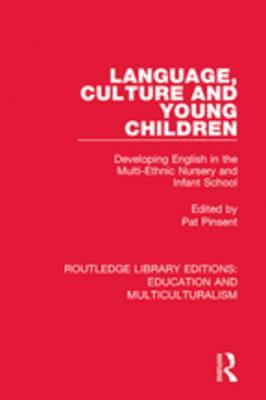
Read Language, Culture and Young Children: Developing English in the Multi-Ethnic Nursery and Infant School - Pat Pinsent file in ePub
Related searches:
Cultural Diversity and Language Socialization in the - flanbwayan
Language, Culture and Young Children: Developing English in the Multi-Ethnic Nursery and Infant School
Promoting Language Diversity in the Early Years and Beyond VLS
Grandfathers in Russian Culture and Language
Immersion: Cultural, Language, and Virtual
How Does Culture Affect the Language Development of a Child
Diversity Through Language, Culture, and Literacy - Kid
CULTURAL INFLUENCES ON EARLY LANGUAGE AND LITERACY EACHING
Y oung children and their families reflect a great and
THE EARLY YEARS: Dual Language Learners - WIDA
Language, Culture, and Adaptation in Immigrant Children - NCBI - NIH
Language, Culture, and Early Childhood: Indigenous Children's
Celebrate tradition and cultural awareness with young children
8 Ways to Show Young Children that Diversity is a Strength The
We are different, we are the same: Teaching young children about
Enhancing Practice with Infants and Toddlers from Diverse
Language and Literacy ECLKC
For infants and toddlers, emerging literacy is embedded in the language and communication domain. This reflects how closely connected these emerging literacy skills are to very young children’s beginning receptive, expressive, and vocabulary skills. For preschoolers, language and literacy are distinct domains.
Young children are natural language acquirers; they are self-motivated to pick up language without conscious learning, unlike adolescents and adults.
An award-winning team of journalists, designers, and videographers who tell brand stories through fast company's distinctive lens what’s next for hardware, software, and services our annual guide to the busine.
This book is designed to help the teacher facing the challenge posed by multi-ethnic, multi-cultural, multi-language classes. The contributions, from teachers and higher education tutors, are based on experience and research in this area and their emphasis is practical with theoretical support being provided where relevant.
A cultural practice is defined as being an object, event, activity, social grouping, or language that people use, produce, and reproduce throughout the event of their normal, everyday lifestyle.
Cultural diversity and young children children bring their own set of culturally based expectations, skills, talents, abilities, and values with them into the classroom. And they begin to develop their self-concept (at least in part) from how others see them.
Representing each child’s language and culture throughout the room is consistent with developmentally appropriate practice. This is important for children’s self-esteem, and exposure to images from diverse cultures is valuable for all children. Visit the public library to find board books in the languages you need.
Infants as young as 4 months who live in bilingual environments can distinguish between two languages, monitoring lip and facial movements. Babies also show a strong preference for the language their mother spoke during pregnancy. Contrary to conventional wisdom, bilingual children are not delayed in language acquisition.
Child and youth programs have an opportunity to help all children develop strong language skills and healthy cultural identities.
• tools to help you better understand children's sociocultural contexts and levels of language.
According to researcher beth maschinot, the language development of children is increased the more adults communicate with them, regardless of cultural experiences. Another similarity found in all children, in spite of their culture, is the ability to recognize speech sounds and to learn language in a sequence.
Children learn to communicate in the context of their home culture. Beginning at birth, children use their home language and culturally accepted communica-tion styles to connect with others in a meaningful way, forming secure relationships that are intrinsic to healthy development.
For example, young children typically develop a conversational style resembling their parents’ – and that often depends on culture. European-american children frequently provide long, elaborative,.
How young children learn language in the early childhood classroom, silence is not golden. Spoken words are opportunities for learning that should take place throughout the day - especially during conversations between children and between teachers and children.
The culture channel contains articles on everything from religion and traditions to history and geography. Advertisement topics to explore: history people why 'poop' and 'wiggle' are funny words, accord.
Learning multiple languages promotes an overall sense of cultural appreciation and understanding.
Our brands we are no longer supporting ie (internet explorer) as we strive to provide site experiences for browsers that support new web standards and security practices.
Because language is such an important component of culture, a child's fluency in the family language will affect his or her sense of identity. The use of the home language also promotes children's cognitive development, self-esteem, second language (usually english) acquisition, and academic preparation.
The irs is now offering critical information in multiple languages. Select from the languages below to view the available information. An official website of the united states government we know that tax information can be hard to understan.
Language and culture are deeply interconnected – and not surprisingly, foreign language learners show increased cross-cultural awareness. Young children exposed to a foreign language show greater empathy in tests where they are required to understand another person’s perspective.
The cognitive benefits of learning a language have a direct impact on a child’s academic achievement. Compared to those without an additional language, bilingual children have improved reading, writing, and math skills, and they generally score higher on standardized tests. Nurture their curiosity, cultural sensitivity, empathy, and tolerance.
Diversity activities teach young children to respect and celebrate the differences learning about different cultural aspects offers new experiences for children. All types of differences such as race, religion, language, tradition.
3 oct 2017 as young children enter their first years of school, they'll get to know peers with a wide variety of abilities, cultures, languages, and backgrounds.
Enjoy thrilling novels, beautiful photo books and keepsake nostalgia collections.
By continuing the practices and culture you enjoy and view as important, in your home, in the way you dress, the language you speak or the food you cook, you are giving your children the opportunity to share, participate in, and value different cultures and by doing so experience a broad, varied and enriched life.
The definition of immersion refers to several things, including being immersed in a language, a culture, and a video game. Immersion, in sociology and anthropology, involves a deep-level personal involvement of an individual with an objec.
Com: negotiating critical literacies with young children: 10th anniversary edition (language, culture, and teaching series) (9780415733175): vasquez, vivian maria: books.
Children in all cultures are born with the capability for language acquisition, and acquire language in roughly the same way: by learning from and imitating the adults around them.
Post Your Comments: