Download The Strategic Management of Higher Education: Serving Students as Customers for International Growth - Hamid Kazeroony | PDF
Related searches:
Making a Risk Management Plan for Your Business
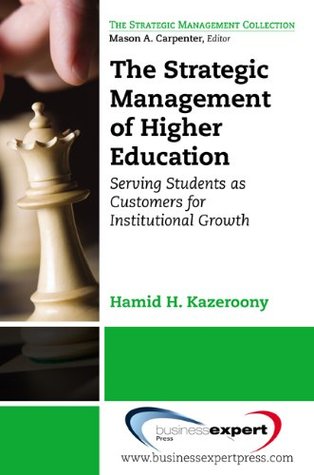
The Strategic Management of Higher Education: Serving Students as Customers for International Growth
(PDF) Leadership, Strategic Planning and Strategic Management for
Approaches to Internationalisation and Their Implications for - OECD
The strategic management tools for higher education institutions
Strategic Planning For Higher Education-Strategic Management
Strategic Planning in Higher Education: A Guide for Leaders
Value Chain for Strategic Management Accounting in Higher
Strategic Management for Competitive Advantage
Conceptual Framework for the Strategic Management: A Literature
Institutional Profiles: Some Strategic Tools Tuning Journal for
Need of Strategic Management for an Organisation (5 Reasons)
Seven principles for higher education change management
Balanced scorecard is analyzed as a strategic management system that translates a higher education institution’s strategy into a comprehensive set of performance measures that provides a framework for a strategic measurement and management system.
Strategic management, strategy for short, is essentially about choice — in terms of what the organization will do and won’t do to achieve specific goals and objectives, where such goals and objectives lead to the realization of a stated mission and vision. Strategy is a central part of the planning function in p-o-l-c.
The higher education authority (hea) is the statutory planning and and skills in the strategic development of the irish higher education and research system. Core functionality such as security, network management, and accessibili.
Strategic marketing management implements your company’s mission through focused processes to get the most out of your existing marketing plan.
Strategic management programs are likely to include a higher proportion of broad-based theory such as economics, strategic management, strategic implementation, competitive strategy, game theory, mergers and acquisitions, and managerial economics.
The compiled papers asses that most universities and institutions of higher education now operate in a highly competitive environment.
Articles deal with various aspects of strategic plan- ning, its definition, process, and application.
Strategic management of organizations involves the leveraging of resources to achieve objectives (barney, 1991.
The effect is especially strong in alliances that anticipate higher hazards.
Strategic management requires ongoing evaluation of the processes and procedures within an organization and external factors that may impact how the company functions. The process of strategic management should guide top-level programs and decisions. Companies of all sizes and in all industries can benefit from the practice of strategic management.
Strategic planning methods can help guide senior management, as well as empower middle universities and higher education systems in the united states.
Bring spend management principles to the leadership level by integrating them into budgeting and strategic planning efforts. Follow a prescriptive, standardized process for spend management that includes stakeholder engagement, adherence to leading practices, data analysis and process refinement to ensure institutionwide adoption.
Higher education institutions (hei) as knowledge centers and human resource developers play a crucial role. Strategic planning and management enables the institutions to increase the adaptability with the environment and improve their performance. So, a well-informed strategic management will increase the overall.
This free innovative report is based on extensive research, conducted by the financial times, into business leaders’ views on the economic challenges and priorities required to grow your business through strategic planning.
Strategic management, linking the rigor of formal planning to vigorous operational execution, may prove to be the answer. A version of this article appeared in the july 1980 issue of harvard.
Strategic management an organization is said to have competitive advantage if its profitability is higher than the average profitability for all companies in its industry. Strategic management can also be defined as a bundle of decisions and acts which a manager undertakes and which decides the result of the firm’s performance.
A set of activities that will assure a sustainable competitive advantage and above-average returns for the firm. A decision-making activity concerned with a firm's internal resources, capabilities, and competencies, independent of the conditions in its external environment.
As internationalisation becomes increasingly integral to university operations, it raises the question of institutional capacity and whether the university is in fact able to respond to the new challenges it is facing. Strategic planning is often proposed as a key tool for a more rational and systematic approach to bringing about the necessary changes for greater internationalisation in institutional direction and daily operations.
The growth of international activities within higher education institutions takes place in a number of different ways ranging from the ad hoc (reactive) to the strategic (proactive). This paper draws on an earlier (1993) empirical study by the author of uk business schools in order to identify the key elements within any process of internationalization and to provide a framework for assessing levels of international activity within institutions.
The strategic decision making process (sdmp) is a major issue in organisations. It is part of the larger topic of strategic management and related to strategic.
Strategic management: characterizing features and key components research into change in the context of educational improvement has clarified the nature and reach of an effective management model for achieving the desired improvements in an educational setting.
In the strategicgoals, five aspects are critical in higher education: the democratization of knowledge and access, the contestability of the market and funding,the research technologies, the global mobility and the integration with the industry. Universities should have strategic plans includingstrategic goals.
The primary goal of stakeholder commitment (or “change management” as it’s commonly referred to in consultant-speak) is to facilitate and sustain the enthusiastic acceptance and adoption of new strategies, technologies, and processes. But far too often, change management in higher education is given short shrift.
The transformation of university governance to strategic board leadership is critically important because higher education won’t be the same once the pandemic is over. Both the general population and the number of traditional students are declining so the demand for higher education may decline.
The strategic management of higher education institutions by get the strategic management of higher education institutions now with o’reilly online learning. O’reilly members experience live online training, plus books, videos, and digital content from 200+ publishers.
Strategic management is the management of an organization’s resources to achieve its goals and objectives. Strategic management involves setting objectives, analyzing the competitive environment.
Join us for this two-day virtual conference, the only training of its kind, designed specifically for volunteer managers in higher education.
The master's in strategic management is a specialisation of the master's programme in business administration at radboud university.
Derived from a comparative study of english and jordanian higher education. The model is supportive of strategic management and a strategic cost analysis,.
Choosing a professional service for investment advice and to help you manage your finances is an important decision.
Strategic management and leadership in higher education abstract for the most part, the organisational forms that are currently being adopted by higher education institutions are grounded in the traditional corporate models of organisation that take a rational approach to organisational design and change management.
A guide for higher education internationalisation and organisation of higher education institutions�.
For rumelt [59], a good strategy is a coherent set of analysis, concepts, policies, arguments, and actions that give responses to a high-risk challenge.
The importance of strategic management in a firm can be answered by analyzing relationship between strategic management and organizational performance. Moreover, mahoney (2012) elaborated that strategic management addresses the organizational structure, resources and capabilities, and the strategic positioning of the organization to create.
Management, based on the principles of university autonomy and accountability, while encouraging links with civil society and local economies. This volume, the second in the series of four, consists of a concise presentation of the nuts and bolts of strategic planning and management in higher education.
Management, relations with civil society, and quality assurance; - to develop national and institutional capacities and skills in higher education strategic management and policy making; - to stimulate the establishment and/or consolidation of new structures and mechanisms of financial management, based on the principles of university.
Whether you run an e-commerce business or a brick-and-mortar operation, if you stock physical products, it's crucial for you to stay on top of your inventory at all times. Often, this involves tracking which items are going out, what's stil.
Discussion of the use of indicators in strategic management in higher education argues that when set in a strategic context and understood appropriately, indicators of quality and performance can be a powerful tool of leadership and decision-making, and can contribute substantially to elaboration of an institution's self-understanding, establishment of priorities, and program evaluation.
Strategic management is all about identification and description of the strategies that managers can carry so as to achieve better performance and a competitive advantage for their organization. An organization is said to have competitive advantage if its profitability is higher than the average profitability for all companies in its industry.
Strategic management is the utilization of key knowledge, skills, techniques, and tools to achieve the organizations’ goals. The aim of strategic management is to provide the organization a well-researched, documented blueprint for the management of the strategic planning cycle.
The strategic management tools for use in higher education institutions have been singled out in the study according to the stages of strategic management.
Therefore, it’s essential for having a plan for its management. You’ll be developing one covering compliance, environmental, financial, operational and reputation risk management.
The research result showed that east kalimantan higher education were not competitive in competition.
In the field of management, strategic management involves the formulation and implementation of the major goals and initiatives taken by an organization 's managers on behalf of stakeholders, based on consideration of resources and an assessment of the internal and external environments in which the organization operates. Strategic management provides overall direction to an enterprise and involves specifying the organization's objectives, developing policies and plans to achieve.
Strategic brand management in higher education offers a unique, robust and useful perspective to all university stakeholders. The book is well organised around a strategic planning structure, updated by contemporary branding developments like co-creation. Building blocks are strategy, planning, co-creation and metrics.
14 feb 2019 certainly, strategic plans are important to academic institutions. A new format in higher education management (the where-to-play decision).
Balanced scorecard is analyzed as a strategic management system that translates a higher education institution\textquoterights strategy into a comprehensive set of performance measures that provides a framework for a strategic measurement and management system.
Needs of higher education – also underscore the importance of strategic planning as one of seven critical components of organizational effec-tiveness. Sphe provides a means to address key planning and change management issues with the kind of holistic approach that fits with these new models and helps foster a culture of continuous assessment.
Strategic management is critical for companies that want to stay relevant in an increasingly competitive market. A strategic plan can be a living, breathing guide for an organization, taking into account priorities, vision and how the compa.
A project is an undertaking by one or more people to develop and create a service, product or goal. Project management is the process of overseeing, organizing and guiding an entire project from start to finish.
Universities began utilizing strategic planning methods in the 1950s, often focusing on budget and planning needs in relation to student recruitment, enrollment and resource growth, facilities and academic programs.
If you're going to become a new manager in a public or private agency, there is a good chance that you will be asked to assist in strategic management. You'll be charged with getting employees and resources coordinated so that your business.
Frans van vught european centre for strategic management of universities to assist higher education institutions in their profiling and positioning strategies.
To achieve the long-term objectives of the business, strategic management plays significant role. The idea of sm consist of formulating, implementing along with evaluating the decisions conducted.
Discover strategic management of innovation networks, 1st edition, müge özman, hb isbn: 9781107071346 on higher education from cambridge.
Strategic management in greek higher education: management of change (full text in greek).
The strategic management of higher education institutions [hamid kazeroony] on amazon.
The article highlights strategic management as a core competence for every higher education institution which understands itself as an autonomous actor.
Could strategic management tools be helpful for management of public universities? pietrzak (2014) as well as pietrzak, paliszkiewicz, and klepacki (2015a) studied the case of implementation of one of such tools, namely balanced scorecard in the publicly held higher education institution and assessed usefulness of this method.
Post Your Comments: